
Get your token first — see Get your access token. You need it in hand, because it is shown only once.
On the MCP page, pick VS Code with GitHub Copilot as your client. The page then shows the endpoint URL of this server, ready to copy.
VS Code runs on your machine, so localhost works here: unlike Claude's remote connector, the endpoint does not have to be public or reachable from the internet.
Add the server
For one workspace, write this in .vscode/mcp.json. For every workspace, run MCP: Open User Configuration from the command palette and write it in the file that opens.
{
  "inputs": [
    {
      "type": "promptString",
      "id": "weblabor-token",
      "description": "Weblabor analyzer token",
      "password": true
    }
  ],
  "servers": {
    "weblabor": {
      "type": "http",
      "url": "<the endpoint the MCP page shows>",
      "headers": { "Authorization": "Bearer ${input:weblabor-token}" }
    }
  }
}
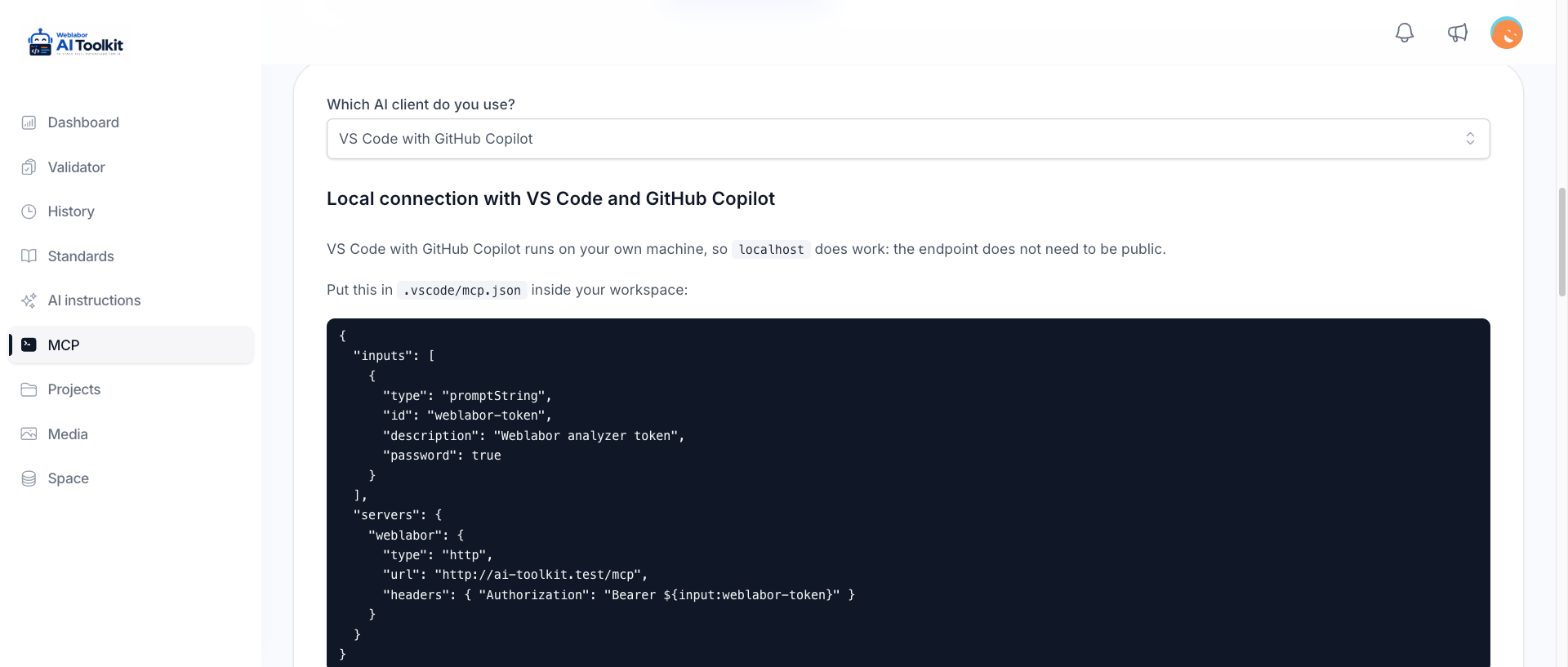
This file is safe to commit
${input:weblabor-token} makes VS Code ask for the token the first time the server starts, and keeps the answer in its own secret storage. The file holds the question, never the answer — so .vscode/mcp.json can go into the repository, and each developer is asked once for a token of their own.
${env:WEBLABOR_ANALYZER_TOKEN} works too, if you would rather keep it in your environment.
The two keys everyone gets wrong
VS Code is the odd one out twice over, and both mistakes are silent — a block copied from another client's instructions is read as nothing at all:
- The top-level key is
servers. Every other client calls itmcpServers. "type": "http"is required here. Cursor must not have it; VS Code must.
Apply a change
After editing the file, run MCP: List Servers from the command palette and restart the server from there.
Do not restrict the tools
Leave the server with all of its tools. Cutting it down to validate_code blocks install_toolkit, get_standard and get_guide, which are what make the rest of this work.
Check the connection
MCP: List Servers shows the server and its state. Then ask your assistant in VS Code for list_rules: it should come back with the configured rules, which confirms both that the token works and that the analyzer is set up.
To test the token before configuring VS Code at all, run this in your terminal. The response contains serverInfo:
curl -X POST <the endpoint the MCP page shows> \
  -H "Authorization: Bearer <your-token>" \
  -H "Content-Type: application/json" \
  -d '{"jsonrpc":"2.0","id":1,"method":"initialize","params":{}}'
When it does not connect
| What you see | Cause | Fix |
|---|---|---|
| The server is ignored and nothing reports an error | the top-level key is mcpServers instead of servers |
rename it |
| The server never starts | "type": "http" is missing |
add it |
| You are never asked for the token | the id in inputs and the one in ${input:...} are not the same string |
make them match |
| Nothing changes after you edit the file | the server is still running with the configuration it started on | restart it from MCP: List Servers |
What works from here
The analyzer, the standards and the guides work from VS Code today: they are read through the server's tools, and nothing is written to your disk, so there is nothing to install for them.
The agents and the commands are files, and they are not written for VS Code yet — see Install the toolkit for which clients get them.
Next
Analyse a file — what to ask for, and what comes back.